Confirmation
Download PDF
Open All
PR54: ZOLL Vector Change/Pad Placement Change
Applicable To
Introduction
Vector change involves repositioning defibrillation electrodes from the conventional anterior-lateral (AL) position to an anterior-posterior (AP) position during cardiac arrest. It may be considered in patients with refractory ventricular fibrillation (VF) or pulseless ventricular tachycardia (pVT) following three or more consecutive unsuccessful defibrillation attempts.
Proceed with vector change when indicated. Consider CliniCall consultation if uncertain about the indication or the procedure, provided consultation does not delay resuscitation priorities.
Indications
Indications:
- Adult patients
- Refractory shockable rhythms
- 3 or more consecutive defibrillation attempts without conversion of rhythm.
- PCP/EMR 3 consecutive analyze-shock advised
- ACP/CCP/ITT 3 consecutive defibrillation attempts of either VF or VT
Contraindications
Procedure
Procedure:
Initial Electrode Placement: Apply defibrillation electrodes in the conventional anterior-lateral (AL) position. This remains the preferred initial placement during adult cardiac arrests.
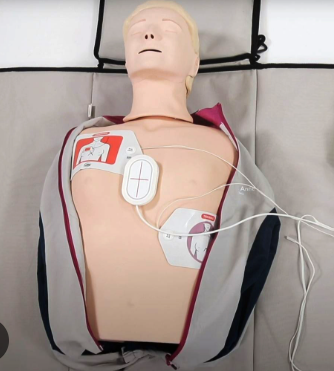
Vector Change: For refractory VF or pVT following three consecutive unsuccessful defibrillation attempts, consider repositioning electrodes to the anterior-posterior (AP) position. Position the electrode marked with the red colour indicator on the posterior chest to the left of the spine, below the scapula. Position the unmarked pad on the left lateral chest. Use new electrodes if adhesion is compromised. Minimize interruptions to chest compressions during repositioning. Consider CliniCall consultation if uncertain about the indication or procedure, provided it does not delay resuscitation priorities.
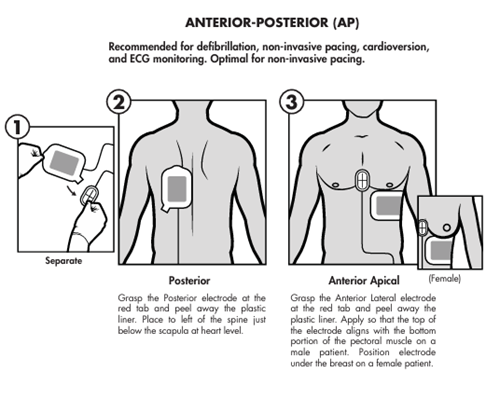
Easy way to remember pad placement: The back of the pad packaging has a diagram for reference. In either situation, place the pad with the red colour indicator over the patients heart in both the A/L postion or the A/P position. For EMR and PCP license levels, the early phone call to CliniCall will typically occur around the same time vector change would be considered and further instruction can be given if any confusion arises.
Notes
Disclaimer:
Anterior–Posterior (AP) pad placement is approved and validated by both Stryker and Zoll for use with all monitors and automated defibrillators currently in service with BCEHS. While an older LP15 user manual advised against AP placement when operating in AED mode, this is no longer the manufacturer’s recommendation. AP pad placement is now confirmed to be safe and appropriate for use in both LP15 AED and manual modes.